
Redefining the Elderly Care Industry through Design: As Partners x DLX
What did a four-month collaboration between DLX Design Lab and As Partners reveal about loneliness, technology in the care industry, and the challenges of building meaningful industry–academia partnerships?
"When I moved here, I decided to cut ties with my university friends."
"I gave up all my hobbies."
These were among the things residents shared with the DLX team during field research inside As Partners' elderly care facilities. What emerged through the research was a deeper understanding of the lived experiences of these residents, and how loneliness can develop not only through physical isolation but also through loss of relationships, routines, and independence.
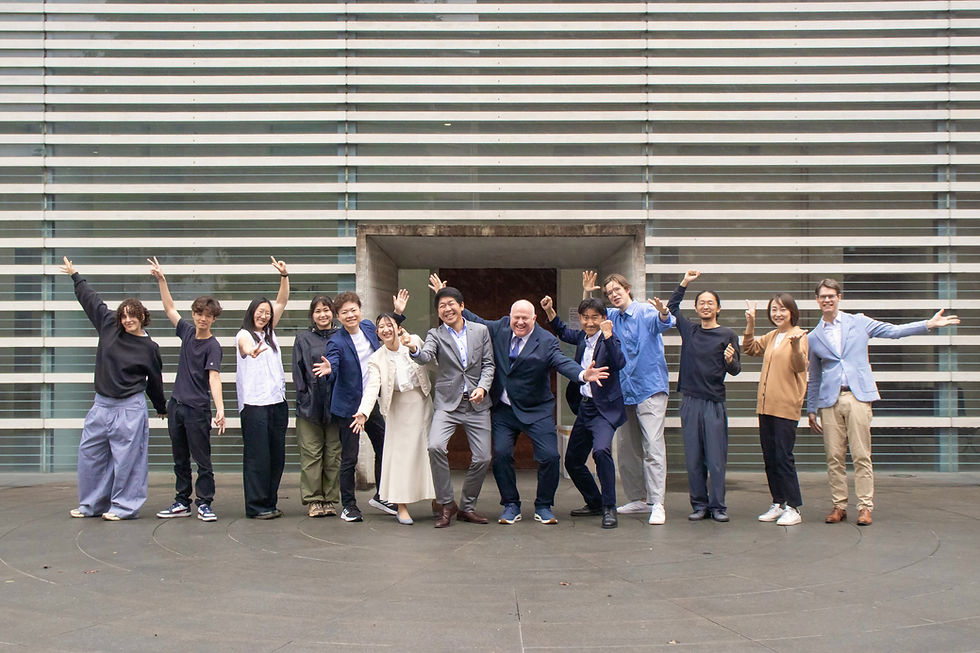
Project Collins began as a four-month collaborative design exploration (January to April 2025) between DLX Design Lab at the University of Tokyo's Institute of Industrial Science and As Partners, an operator of more than 25 elderly care facilities across the Tokyo metropolitan area. With loneliness becoming an increasingly urgent challenge in Japan's aging society, the team set out to explore how design might foster joy, connection, and meaning within elderly care communities.
The resulting concepts ranged from hydration spaces that double as community hubs to biosensors that gently tune into residents' emotional states. Using a future-oriented design approach, the project highlighted new areas of opportunity that balanced creative exploration with the everyday realities of care.
One year after the project concluded, Professor Miles Pennington from the DLX Design Lab and As Partners President & CEO Kenji Uemura sat down to talk through what the work brought to light. The following are a few of the topics that were discussed during the interview.

Loneliness and Elderly Care
It's a topic that touches almost everyone eventually, in one way or another.
Miles Pennington: Loneliness is a topic close to home. My mother is in a nursing home in the UK. I remember the hardest part of moving her into a nursing care home was taking her away from her friends and the place she knew. She was so lonely there. For many months, she was packing her bags every day and wanting to go home.
Kenji Uemura: Previously in Japan, senior residential options were not really described as "homes," they were more like facilities or hospitals. These places often offer recreation for the residents, but they can often feel like kindergarten activities and I often saw the boredom on the residents faces. I realized that each resident has their own desires of how they want to live their lives, and I wanted to help each of them live a life they could enjoy.
Technology in the Care Industry
Technology can take on a lot, but not the most human parts of care.
Uemura: For about eight years, we have been working to improve care quality and efficiency through utilising technology, and we aim to expand these innovations across the industry. With Japan's population aging and its workforce shrinking, the key to solving these challenges is productivity improvement, with technology at the core of that transformation.
But while technology might be able to cover a significant portion of the caregiving role, the so-called "three major care tasks" - toileting, bathing, and eating - remain challenging. These forms of assistance also involve emotionally sensitive interactions and can also be important opportunities to notice changes in a person's physical condition. For that reason, I believe there will ultimately still need to be human involvement in basic care giving.
Pennington: Technology should be able to help. Right now, we're going through a revolution in AI and robotics, and these things could have massive impact. But at the same time, it's a very human-centered problem. Caregiving is care-giving; care is the important point. It's human to human, so technology alone can't necessarily solve it. We need to think how human-centered technology applications can create solutions.
Industry-Academia Collaboration
The most important work happens before the project begins: aligning goals and expectations.
Pennington: There is often a gap in understanding between the university and the public, but there are many ways of bridging that gap - for example: communicating research to the public in interesting ways so they can understand it, involving the public in research activities, changing research into real-world products or services, or allowing researchers to think about their research and their impact on society. Of course, part of "society" are companies and enterprises. So another thing we do at DLX is to connect enterprises with the research of the university.
Uemura: For companies, the number one value of teaming up with a university is knowledge. While the goal for research is often publishing papers, I think there is value in companies collaborating while the research is still ongoing to think about how we can bring it to the public through products or services.
Pennington: Places like DLX Design Lab can act as a bridge between research and society, university and company. When thinking about industry-academia collaborations, I think one of the most important points is to understand the difference of time scales. University research is always exploring the forefront of knowledge; an academic’s goal is to find new knowledge to expand our understanding of the world, and that can take time. But for companies, timeframes are usually shorter. They want to create business opportunities in the near-term. So sometimes, there is a disconnect between business and researchers, and it takes time to create mutual understanding of these different needs and objectives. And we often use design to communicate and enable this understanding.
Uemura: I think it's important that we have an aligned timeline and purpose. Without that, companies can't really take any action. It doesn't need to be completely figured out, and there will be trial and error, but having an aligned vision I think would allow not just one company, but multiple companies to come together at an industry or even societal scale.
Pennington: I think the kind of framework that enables companies and universities to work together effectively has to be built over the long term. It's a different kind of R&D to commercial R&D, where you have a clear goal to achieve. It's not high-speed projects that quickly become profit making, it's a longer-term relationship that allows joint exploration.
Uemura: I agree; often as a company we can't be doing pure R&D that lasts for a long time. That's why if you can get industry and academia to come together with a unified goal, it is a very powerful tool.
2026/6/26
Miles Pennington
Professor, The University of Tokyo
Professor Miles Pennington specializes in design-led innovation and serves as Director of the DLX Design Lab. After holding positions as Professor and Head of Department at the Royal College of Art in the UK, he joined the Institute of Industrial Science at the University of Tokyo as a Professor in 2017 and also serves as Special Advisor to the President of the University of Tokyo.
Kenji Uemura
President & CEO, As Partners CO.,LTD.
Kenji Uemura leads both the senior care business, centered on assisted living facilities, and the real estate business, driving digital transformation in the care industry through IoT systems such as EGAO link®. After working in housing development and management at Recruit Cosmos and Takara Komuten, he founded AS Partners in 2004. He also serves as Vice Representative Director of the Japan Association of Paid Nursing Homes.
